 Porta Potty Rental Syracuse Co.
Winter Porta Potty Rental
Cold-weather units differ from summer units in three concrete ways. First, the tank gets a winter-grade deodorizer that resists freezing instead of the standard blue water charge, so the contents stay pumpable down…
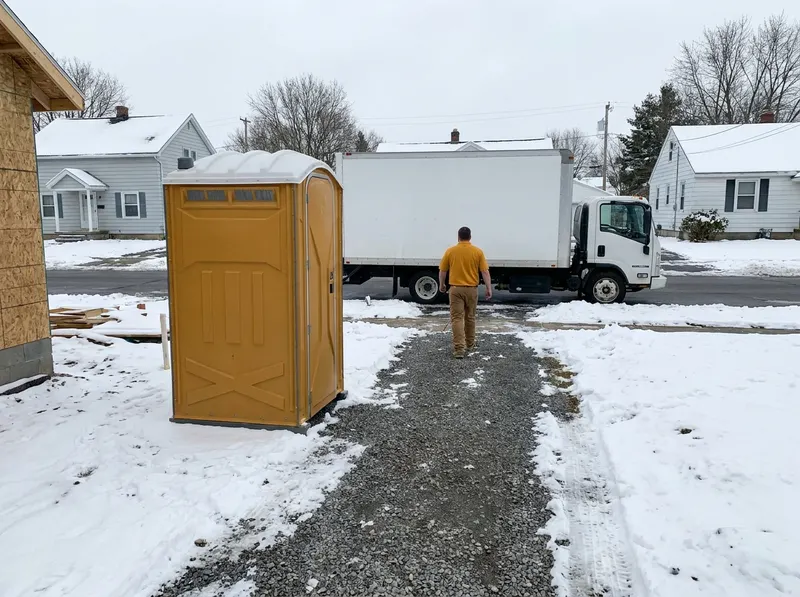
- Included: one standard portable restroom, antifreeze-type tank charge, gel hand sanitizer dispenser, toilet paper, weekly pump-out and restock, delivery and pickup on dated appointments.
- How fast: most Syracuse deliveries land within 1–3 business days; snow-emergency days and plow backlogs can push a window, and you'll be told before the truck rolls, not after.
- Cost: expect roughly $250–$300 per month for one winter-serviced standard unit in Onondaga County — a ballpark range, with the exact number confirmed after a free on-site look.
- What we take: construction and event waste only — liquid and solid restroom waste, paper, and the tank charge. No trash bags, no paint, no chemicals, no oil dumped in the tank.
- How to book: call (680) 239-3320 with the address, gate or driveway access, crew size or guest count, and your start date; you get a written quote with delivery and pickup dates on it.
Cold-weather units differ from summer units in three concrete ways. First, the tank gets a winter-grade deodorizer that resists freezing instead of the standard blue water charge, so the contents stay pumpable down through the deep cold. Second, sink units with fresh-water tanks are a liability once nights drop into the teens — lines and pumps freeze and split — so winter sites run gel sanitizer dispensers mounted inside the unit. Third, placement stops being flexible. A unit set on packed snow will sit level in December and lean by January once the base melts out underneath it, so we look for asphalt, gravel, or plywood over frozen ground, and we look for a spot the plow driver won't bury.
That plow question decides more Syracuse jobs than the weather does. Lake-effect bands off Lake Ontario can drop a foot on Eastwood and Valley while a site on University Hill gets three inches, and the snow that lands on your lot ends up in a windrow somewhere. If the unit is at the edge of the parking area, it becomes part of the snowbank and the service truck can't get a hose to it. On tight residential streets in Tipperary Hill, Westcott, and Hawley-Green, the useful move is usually setting the unit in the driveway apron or on the contractor's side yard rather than at the curb, because the curb line belongs to the city plow from December to March. Hillside addresses off Strathmore and Tipperary Hill add a second problem — a truck needs a route it can climb loaded, and a unit needs to sit somewhere it won't slide.
Winter service frequency stays weekly on most sites, not monthly. Cold slows odor, and crews sometimes assume that means service can stretch. What actually happens is usage keeps stacking up while heat is gone, and a tank that goes three weeks in January is a tank that's hard to empty and unpleasant to walk into. Weekly pump-out with a fresh winter charge keeps it usable. If a jobsite in the Near Westside or a lakefront project near Franklin Square needs an off-schedule visit — extra trades on site, a doubled headcount, a unit knocked over by wind — call it in and we schedule it as its own visit rather than making you wait for the route.
Winter rental fits a specific set of jobs: multi-phase builds and renovations that run straight through the season, hospital and campus work around University Hill and Upstate Medical University where crews can't leave the site to find a restroom, municipal and utility work in Onondaga County that doesn't stop for weather, and cold-season events — winter shows at the New York State Fairgrounds, a Onondaga Lake Park event, a Clinton Square crowd — where the plumbing indoors either doesn't exist or can't take the volume. The alternative is a heated restroom trailer, which is genuinely more comfortable and genuinely more expensive, and needs power plus a plowed, near-level pad big enough to park it. For a framing crew of eight in Sedgwick, a treated standard unit is the honest answer. For a black-tie event or a long-term office trailer complex, a trailer earns its cost.
The trade-off worth stating plainly: a winter unit is not a warm unit. It stays clean, it stays serviced, it stays functional in single digits — it does not stay heated unless you're renting a trailer. Anyone who tells you a standard poly restroom is cozy in a Syracuse January is selling. What you can hold us to is the part that's actually controllable: dated delivery, dated pickup, weekly service on the calendar, and every fee written down before the truck leaves the yard.
What it costs
Every job gets a firm, written price after a free on-site visit.
Common questions
Do porta potties freeze in a Syracuse winter?
Can I still get a hand-washing station in Syracuse during winter?
How often will you service a winter porta potty rental on a Syracuse jobsite?
What do you need from me for winter delivery in neighborhoods like Eastwood or Tipperary Hill?
Ready to get started?
Tell us about your winter porta potty rental job in Syracuse and we'll send a clear, written quote — usually the same day.