 Porta Potty Rental Syracuse Co.
Portable Restroom Trailer Rental
The trade-off is honest: a trailer costs several times what a standard unit costs, and it needs access a plastic unit does not. A trailer arrives behind a pickup, so it needs a straight approach, firm level ground, and…
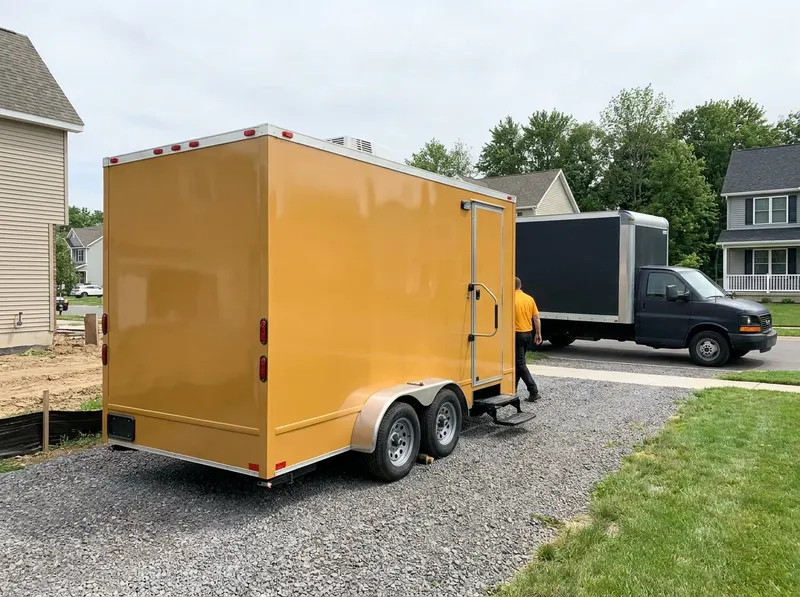
- What's included: a towed restroom trailer with flushing toilets, sinks with running water, mirrors, interior lighting, ventilation, and heat or air conditioning, plus fresh-water fill and waste-tank service.
- Sizes: 2-station trailers for backyard weddings and small graduations, 3–4 station units for mid-size events, and 8–10 station trailers for festivals and multi-day gatherings in Onondaga County.
- How fast: trailers are a limited fleet item, so book 2–4 weeks out for June graduation weekends and Fairgrounds season; short-notice placement depends on what is back in the yard and cleaned.
- Cost: expect roughly $700–$1,400 for a 2-station trailer on an event weekend and $1,600–$3,800 for larger multi-station units — market-range ballparks, exact number confirmed after a site look.
- How to book: call (680) 239-3320 with the address, guest count, event hours, and whether you have a 110V outlet and a garden hose within reach — you get a written quote with the delivery and pickup dates on it.
The trade-off is honest: a trailer costs several times what a standard unit costs, and it needs access a plastic unit does not. A trailer arrives behind a pickup, so it needs a straight approach, firm level ground, and room to back and unhook — figure a parking-space footprint for a 2-station and a good deal more for a 10-station. That's easy at the Fairgrounds or in an open field off Onondaga Lake Parkway. It's harder on Tipperary Hill, where driveway grades are steep enough that we will often stage the trailer on the flat street apron instead of trying to level it up top. Strathmore and Sedgwick have narrow older driveways with mature maples overhead, and Hawley-Green has one-way blocks with parked cars on both sides — on those streets we look at the site first rather than guess, because a trailer that can't get in is a wasted delivery day for both of us.
Hookups decide the rest. Most trailers run best on a standard 110V/20A outlet and a garden hose spigot, which keeps the water hot, the heat or A/C running, and the tanks topped off. No power available? A generator gets added, and that changes the number. In Westcott and Near Westside where street parking is tight, we plan the cord and hose route ahead of time so nobody is running an extension across a sidewalk full of guests. For a University Hill graduation party in the JMA Wireless Dome weekend crush, the practical constraint is usually not the trailer — it's that the block is full of visiting families' cars by 9 a.m., so we deliver the day before and set it where it won't get boxed in.
Winter is its own conversation. Lake-effect cold in Syracuse will freeze a trailer's water lines fast if power drops, so a January or February placement runs either on continuous power with the interior heat on, or winterized with the fresh-water system drained and only flush capability retained. We'll tell you plainly which one your site can support. That's also why long-term trailer rentals on Eastwood and Valley renovation projects — homeowners living through a gutted bathroom — get scoped as monthly placements with a set service day rather than a one-off drop.
On service frequency: an event trailer is delivered clean, stocked, and inspected, then pumped and reset on the schedule we put in writing. A weekend event usually needs no mid-event service under 150 guests. Longer runs, high-traffic festivals, and multi-day placements get scheduled attendant visits or added pump-outs, and heavier use means more frequency — not a surprise line item later. Everything we quote lists delivery date, pickup date, and service days, so you can compare our number against anyone else's apples to apples. If a unit needs attention off-schedule, call the dispatch number and we route a truck; that's the whole point of being local instead of a broker.
When a trailer is overkill: rough framing crews, dusty excavation phases, and short outdoor work sessions are better served by standard units, which cost less and tolerate mud, boots, and forklift traffic. A trailer belongs where appearance and comfort matter — tented weddings, church and school events, Clinton Square-adjacent private functions, film and production days, ADA-accessible guest needs, and any site where the client has guests in dress shoes.
What it costs
Every job gets a firm, written price after a free on-site visit.
Common questions
How much does a restroom trailer rental cost in Syracuse?
Does a restroom trailer need power and water at my Syracuse property?
Will a restroom trailer fit a narrow Syracuse driveway or a one-way street?
Can I rent a restroom trailer in Syracuse in winter?
How far ahead should I book a restroom trailer for a Syracuse graduation or festival?
Ready to get started?
Tell us about your portable restroom trailer rental job in Syracuse and we'll send a clear, written quote — usually the same day.