 Porta Potty Rental Syracuse Co.
Standard Portable Toilet Rental
A standard unit is the right call when the users are workers or casual guests and nobody needs a sink at the door. On a Valley or Eastwood renovation, one unit parked at the side of the driveway keeps a four-man crew…
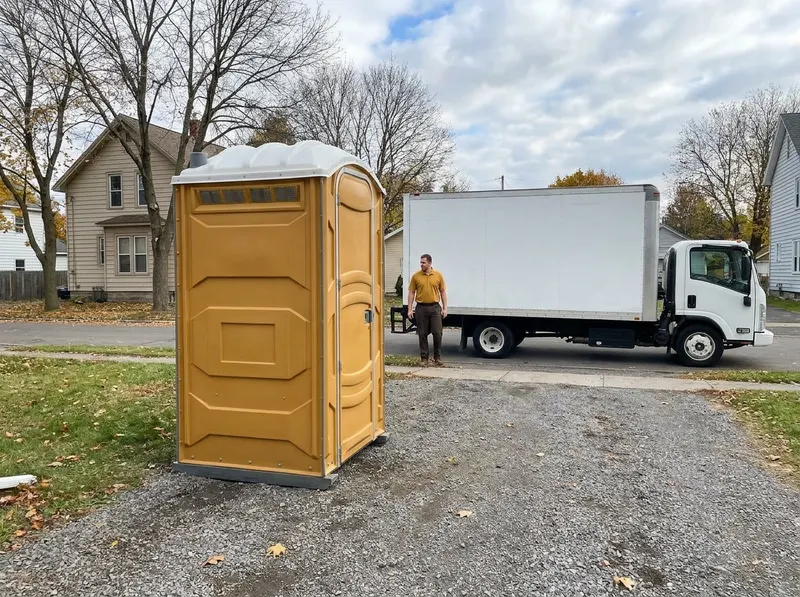
- What's included: one standard unit, delivery, pickup, and scheduled pumping/restock (toilet paper, sanitizer) at the frequency written on your quote.
- How fast: most Syracuse-area drops are scheduled within 1–3 business days; the delivery date is confirmed in writing before the truck rolls.
- What it costs: a standard unit runs roughly $250–$400 per month on a construction rental and about $250–$275 for a weekend event, delivery and pickup included in the quoted figure.
- What we take: the waste, the paper, and the unit itself at pickup — nothing is left behind on your site or lawn.
- How to book: call (680) 239-3320 with the address, the number of people, and your start and end dates, and you get a written quote with the dates attached.
A standard unit is the right call when the users are workers or casual guests and nobody needs a sink at the door. On a Valley or Eastwood renovation, one unit parked at the side of the driveway keeps a four-man crew out of the homeowner's bathroom for the whole job. For a graduation party in Strathmore or a block gathering off Westcott, one or two standards handle a few hours of guests without turning the yard into a plumbing project. Where the standard is the wrong unit: if you need wheelchair access for a public event or an ADA-covered jobsite, that requires the larger accessible unit, not this one. If you are hosting a wedding reception or anything where guests are dressed up for hours, the flushing/sink-equipped unit is worth the upgrade. The trade-off is honest — a standard has no flush and no running water, only a sanitizer dispenser, and that is exactly why it costs the least.
Count units before you book, not after the complaints start. The working rule for construction is one standard unit per 10 workers on a 40-hour week, with weekly service. Push past 10 users per unit and weekly pumping stops being enough, so we either add a unit or move you to twice-weekly. For events, plan on one unit per 50 guests for a 4-hour window, and add roughly 30% if beer or wine is being served or the event runs past 5 hours. Syracuse has predictable crunch weeks — May and June around JMA Wireless Dome commencement weekend, the run-up to the New York State Fairgrounds season, and Onondaga Lake Park tournament Saturdays — and units book out first in those windows. Ten days of lead time in June is worth more than any discount.
Placement is where most deliveries go sideways, so check three things before the truck comes. First, ground: firm and reasonably level. Late-March thaw around Near Westside and Valley job sites turns access lanes into soup, and a service truck sinking in mud is a missed pumping. Second, truck access — we need to get within about 50 feet of the set point with a clear overhead path, which matters on the narrow one-way stretches of Tipperary Hill and the tight alleys behind Hawley-Green where mature trees hang low. Third, distance from the work face or the party: close enough that people actually walk to it, far enough that it is not sitting under a dining tent. On University Hill and around Upstate Medical University, street placement usually needs the property manager's sign-off and sometimes a city permit for sidewalk or right-of-way use; we will tell you which one applies rather than dropping a unit and hoping.
Winter service is a real Syracuse line item, not fine print. Lake-effect snow off Onondaga Lake buries units near Lakefront/Franklin Square, so we ask that a path stay plowed to the door — a unit walled in by a snowbank cannot be pumped, and skipped pumping is the fastest way to a unit nobody will use. Winter units get a non-freeze additive in the tank and we schedule around plow days where we can. Long-haul mileage outside the immediate metro and any extra-frequency servicing show up on the written quote up front, with dates, so you can compare our number against anyone else's line by line.
What it costs
Every job gets a firm, written price after a free on-site visit.
Common questions
How much does a standard porta potty cost to rent in Syracuse?
How often do you service a standard unit in Syracuse?
Can you deliver one standard unit to a residential street in Syracuse?
Does a standard portable toilet meet accessibility requirements in Syracuse?
How far in advance should I book a standard unit for a Syracuse event?
Ready to get started?
Tell us about your standard portable toilet rental job in Syracuse and we'll send a clear, written quote — usually the same day.